
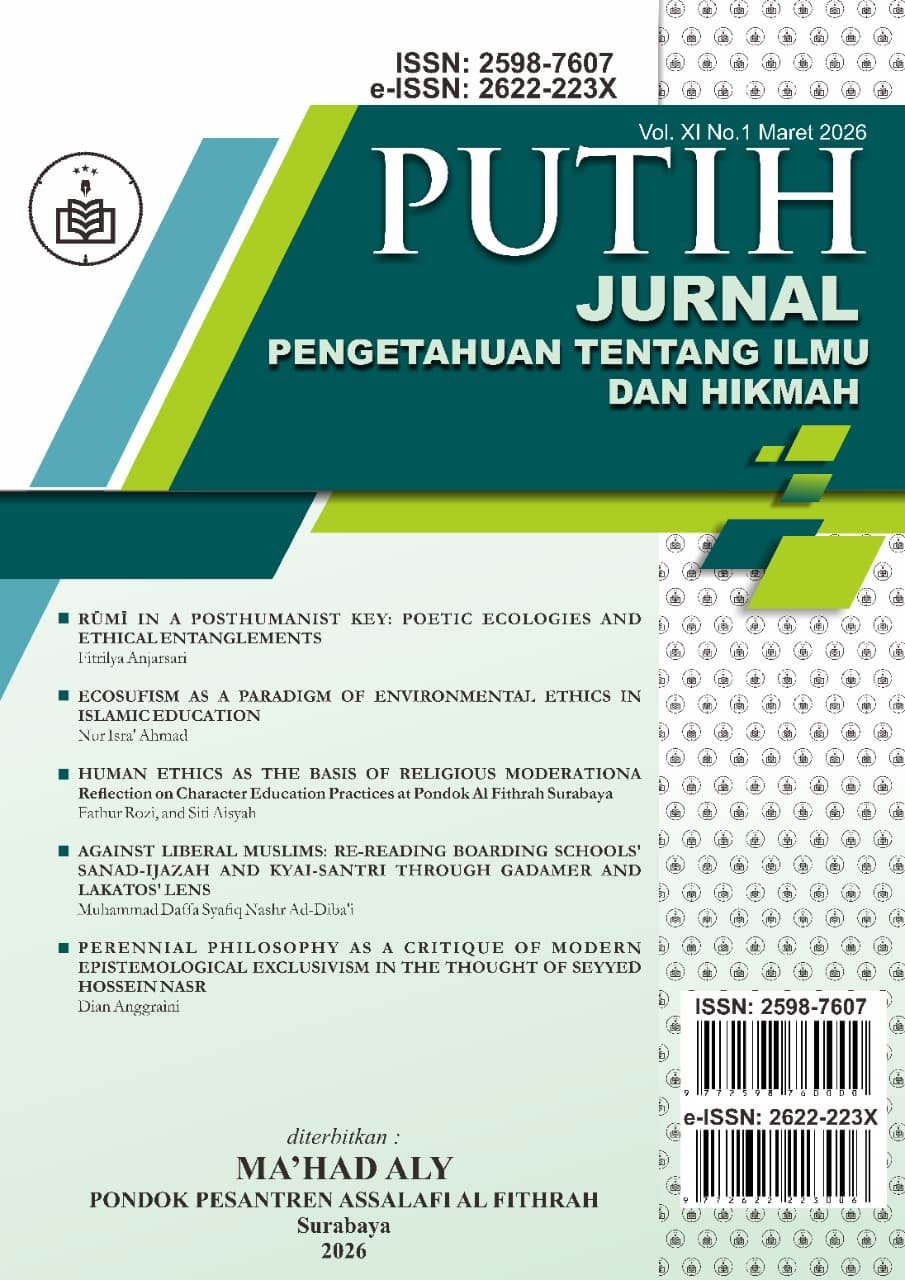
Human Ethics as the Basis of Religious Moderation A Reflection on Character Education Practices at Pondok Al Fithrah Surabaya
Article Sidebar
Main Article Content
Abstract
This article examines the role of human ethics as a foundation for fostering religious moderation, with a particular focus on character education practices at Pondok Al Fithrah Surabaya. In the contemporary era, where religious polarization and intolerance remain pressing challenges, pesantren institutions play a crucial role in nurturing balanced and inclusive perspectives among young Muslims. Human ethics, understood as universal values such as justice, compassion, tolerance, and respect for human dignity, provides an essential framework for developing a moderate religious attitude rooted in Islamic spirituality. The study employs a qualitative-descriptive approach, drawing on observations, interviews with educators and students, and document analysis at Pondok Al Fithrah. Findings suggest that the pesantren integrates human ethics into daily practices, including the cultivation of humility, discipline, cooperation, and respect for diversity in religious and social life. These values are embedded not only in the formal curriculum but also in extracurricular activities, communal rituals, and the living tradition of Sufi-oriented education. Moreover, the article highlights how Al Fithrah’s approach contributes to the broader discourse of religious moderation in Indonesia by promoting harmony, preventing radical tendencies, and encouraging constructive engagement with plural society. It concludes that the integration of human ethics in character education at pesantren serves as a practical model for shaping moderate, ethical, and socially responsible individuals, thereby reinforcing the role of Islamic boarding schools as vital agents of peacebuilding and moral development in the 21st century.
Downloads
Article Details
Section
References
Appleby, R. Scott. The Ambivalence of the Sacred: Religion, Violence, and Reconciliation. Lanham: Rowman & Littlefield, 2000.
Azra, Azyumardi. “Cultural Pluralism in Indonesia: Continuous Reinventing of Indonesian Islam in Local, National and Global Contexts.” Asia Pacific Journal on Religion and Society 2, no. 2 (November 2018): 57. http://dx.doi.org/10.24014/apjrs.v2i2.6399.
———. Moderasi Beragama dalam Konteks Indonesia. Jakarta: Prenadamedia Group, 2021.
Braun, Virginia, dan Victoria Clarke. “Using Thematic Analysis in Psychology.” Qualitative Research in Psychology 3, no. 2 (2006): 77–101. https://doi.org/10.1191/1478088706qp063oa.
Cohen, Louis, Lawrence Manion, dan Keith Morrison. Research Methods in Education. London: Routledge, 2011.
Creswell, John W. Research Design: Qualitative & Quantitativee Approach. London, New Delhi: Sage Publications, 1994.
Dhofier, Zamakhsyari. Tradisi Pesantren: Studi Pandangan Hidup Kyai dan Visinya Mengenai Masa Depan Indonesia. Jakarta: LP3ES, 2011.
Esposito, John L. Islam and Peacebuilding: Political and Religious Values. DC Washington: Georgetown University Press, 2010.
Fadl, Khaled Abou El. Islam and the Challenge of Democracy. Princeton: Princeton University Press, 2005.
Ghazali, Abu Hamid (al-). Iḥyā’ ‘Ulūm al-Dīn. Beirut: Dar al-Kutub al-Ilmiah, 2005.
Harvey, Peter. An Introduction to Buddhist Ethics. Cambridge: Cambridge University Press, 2000.
Hefner, Robert W. Civil Islam: Muslims and Democratization in Indonesia. Princeton: Princeton University Press, 2000.
Kementerian Agama Republik Indonesia. Moderasi Beragama. Jakarta: Badan Litbang dan Diklat Kementerian Agama RI, 2019.
Küng, Hans. A Global Ethic for Global Politics and Economics. Oxford: Oxford University Press, 1998.
Lickona, Thomas. Educating for Character: How Our Schools Can Teach Respect and Responsibility. New York: Bantam Books, 1991.
MacIntyre, Alasdair. After Virtue: A Study in Moral Theory. Notre Dame: University of Notre Dame Press, 2007.
Majid, Nurcholish. Islam: Doktrin dan Peradaban. Jakarta: Paramadina, 1992.
Nasr, Seyyed Hossein. Knowledge and the Sacred. New York: Crossroad, 1981.
Ramadan, Tariq. Radical Reform: Islamic Ethics and Liberation. Oxford: Oxford University Press, 2009.
Reza, Achmad Ali, dan Nadia Aulia Nadhirah. “Adaptation and Resilience: A Narrative Study on Grit among Santri in Pesantren Environments.” Santri: Journal of Pesantren and Fiqh Sosial 6, no. 2 (2025): 171–86. https://www.journal.ipmafa.ac.id/index.php/santri/article/download/1711/701.
Schimmel, Annemarie. Mystical Dimensions of Islam. Chapel Hill: University of North Carolina Press, 1975.
Spradley. Participant Observation. United States of America: Holt, Rinehart and Winston, 1980.
Sugianto, Hendi, dan Farnela Diva. “Pendidikan Moderasi Beragama di Pesantren (Studi Kasus di Pondok Pesantren Harisul Khairaat Kota Tidore Kepulauan).” Al-Riwayah: Jurnal Kependidikan 15, no. 2 (2023): 167–87. https://doi.org/10.47945/al-riwayah.v15i2.1140.
Taylor, Charles. A Secular Age. Cambridge, MA: Harvard University Press, 2007.
Tu, Weiming. Confucianism and Human Rights. New York: Columbia University Press, 1998.
Wahyudin, Aji, Rohmad, dan Fadhil Akbar. “Khidmah System as a Model for Human Resources Development and Character Education in Islamic Boarding Schools,” Jurnal Islam Nusantara 9, no. 2 (2025): 271.” Jurnal Islam Nusantara 9, no. 2 (2025).
Zaman, Mohamad Badrun, dan et.al. “Harmonisasi Pendidikan Islam dan Negara: Pengarusutamaan Nilai-nilai Pancasila dalam Orientasi Pendidikan Pesantren di Indonesia.” Jurnal Tarbawi 10, no. 2 (2022): 139–64. https://jurnal.alfithrah.ac.id/index.php/tarbawi/article/view/213.