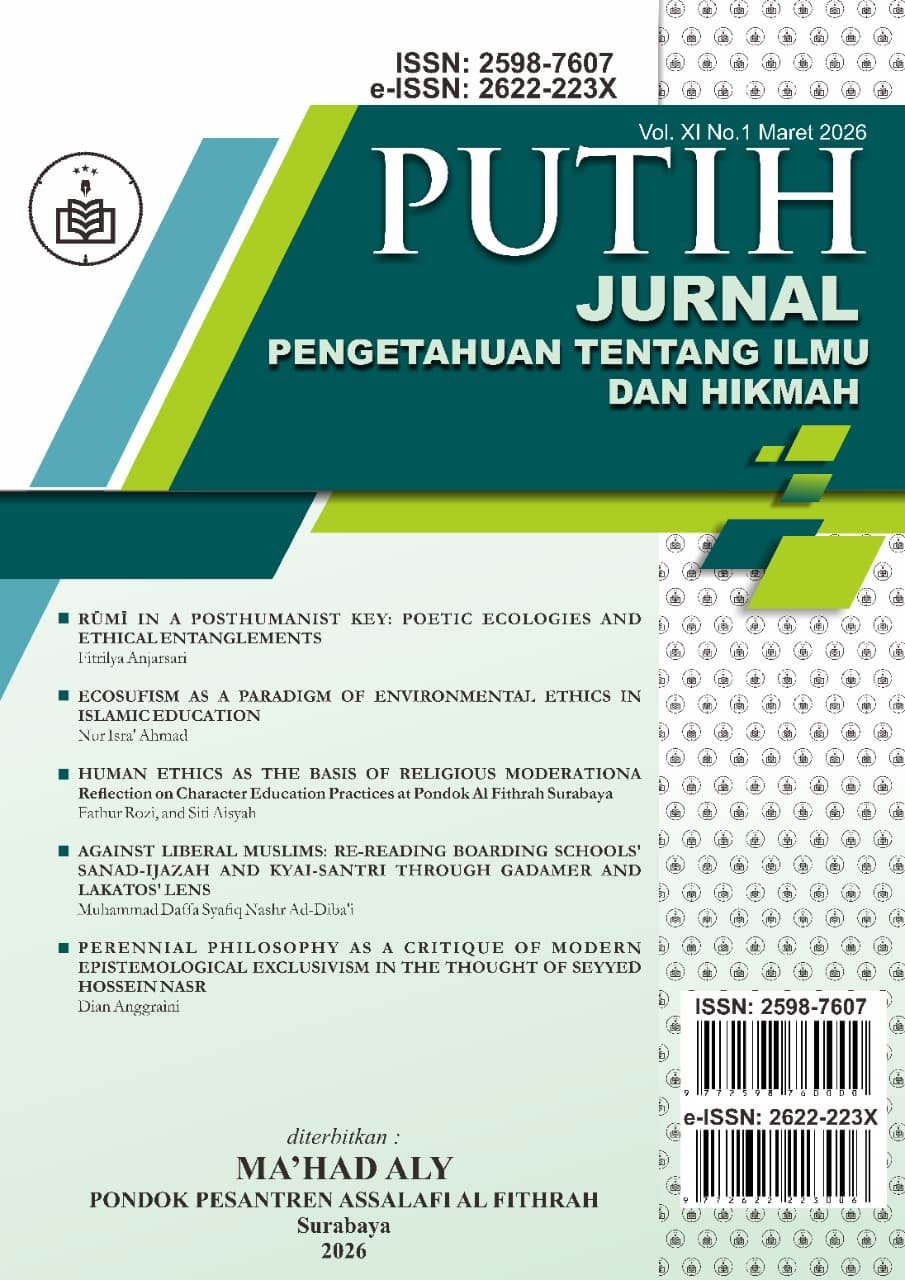
Rumi in a Posthumanist Key: Poetic Ecologies and Ethical Entanglements
Article Sidebar
Main Article Content
Abstract
Amidst ecological degradation and the acceleration of technoscience, post-humanist ethics are increasingly seeking a vocabulary of responsibility that transcends human exceptionalism. However, existing scholarship rarely brings together Sufi metaphysics and post-humanist theory in a sustained manner, and studies of Rūmī often treat the agency of animals, materials, and supernatural entities merely as metaphors. Through the poetic framework of Jalāl al-Dīn Rūmī, this article bridges this gap by reading selected ghazals and passages from the Masnavī alongside Rosi Braidotti’s relational subject, Karen Barad’s agential realism, and Donna Haraway’s figures of companionship. This article develops a “poetic ecology” as an interpretative method that highlights attention, resonance, and adab as practices of being-with animals, materials, technologies, and invisible beings. Methodologically, this article combines close reading, intertextual interpretation, and conceptual translation, treating images of wind, flutes, moths, and light as sites where agency is distributed and responsibility is felt. Key findings suggest that dhikr and samāʿ function as an ethics of entanglement that disciplines perception, loosens the boundaries between self and world, and shifts responsibility from command towards “response-ability”. This framework explains how devotion can operate as an ethics of entanglement, rather than as a human-centred moral command. Brief vignettes on urban pollution, data infrastructure, and AI in the classroom demonstrate how Rūmī’s imagination can guide ecological care, reparative listening, and humane design. This article reinterprets the khalīfah as a companion species and formulates practical adab for institutional, pedagogical, and technological contexts.
Downloads
Article Details
Section
References
Alaimo, Stacy. Bodily Natures: Science, Environment, and the Material Self. Bloomington: Indiana University Press, 2010.
Arberry, A. J. trans., Mystical Poems of Rūmī: First Selection, Poems 1–200. Chicago: University of Chicago Press, 1968.
Barad, Karen. Meeting the Universe Halfway: Quantum Physics and the Entanglement of Matter and Meaning. Durham, NC: Duke University Press, 2007.
Bennett, Jane. Vibrant Matter: A Political Ecology of Things. Durham, NC: Duke University Press, 2010.
Birks, Melanie. Ysanne Chapman. and Karen Francis. “Memoing in Qualitative Research: Probing Data and Processes,” Journal of Research in Nursing 13, no. 1 (2008): 68–75, https://doi.org/10.1177/1744987107081254.
Bürgel, J. Christoph “‘Speech Is a Ship and Meaning the Sea’: Some Formal Aspects of the Ghazal Poetry of Rūmī,” in Poetry and Mysticism in Islam: The Heritage of Rūmī, ed. Amin Banani, Richard Hovannisian, and Georges Sabagh. Cambridge: Cambridge University Press, 1994.
Chittick, William C. The Sufi Path of Love: The Spiritual Teachings of Rumi. Albany: State University of New York Press, 1983.
Dooren, Thom van. Eben Kirksey. and Ursula Münster. “Multispecies Studies: Cultivating Arts of Attentiveness,” Environmental Humanities 8, no. 1 (2016): 1–23, https://doi.org/10.1215/22011919-3527695.
Ernst, Carl W. Sufism: An Introduction to the Mystical Tradition of Islam. Boston: Shambhala, 2011.
Fahm, Abdul Gafar Olawale. “Reflections on Rumi’s Mathnawi and Ecological Spirituality: Introducing an African Perspective,” Afkar: Jurnal Akidah dan Pemikiran Islam 26, no. 2 (2024): 295, https://doi.org/10.22452/afkar.vol26no2.9.
Ferrando, Francesca. Philosophical Posthumanism. London: Bloomsbury Academic, 2019.
Foltz, Richard C. Animals in Islamic Tradition and Muslim Cultures. Oxford: Oneworld, 2006.
Hamid, Farooq. “Storytelling Techniques in the Masnavī-yi Maʿnavī of Mowlana Jalal al-Din Rumi: Wayward Narrative or Logical Progression?” Iranian Studies 32, no. 1 (1999): 27–49, https://doi.org/10.1080/00210869908701944.
Haraway, Donna J. Staying with the Trouble: Making Kin in the Chthulucene. Durham, NC: Duke University Press, 2016.
Keshavarz, Fatemeh. Reading Mystical Lyric: The Case of Jalāl al-Dīn Rūmī. Columbia: University of South Carolina Press, 1998.
Khalil, Atif. “Humility in Islamic Contemplative Ethics,” Journal of Islamic Ethics 4, no. 1–2 (2020): 223–52, https://brill.com/view/journals/jie/4/1-2/article-p223_10.xml#top.
Latour, Bruno. Facing Gaia: Eight Lectures on the New Climatic Regime trans, Catherine Porter. Cambridge, UK, and Medford MA: Polity, 2017.
Lewis, Franklin D. Rumi: Past and Present, East and West: The Life, Teaching, and Poetry of Jalāl al-Dīn Rumi. Oxford: Oneworld, 2000.
Mojaddedi, Jawid. Beyond Dogma: Rumi’s Teachings on Friendship with God and Early Sufi Theories. New York: Oxford University Press, 2012.
Morton, Timothy. Dark Ecology: For A Logic of Future Coexistence. New York: Columbia University Press, 2016.
Murata, Sachiko. The Tao of Islam: A Sourcebook on Gender Relationships in Islamic Thought. Albany: State University of New York Press, 1992.
Nicholson, Reynold A. trans., The Mathnawi of Jalālu’ddīn Rūmī, 8 vols. London: Luzac, 1925–40.
Osborne, Lauren. “Muslim Environmentalisms: Religious and Social Foundations by Anna M. Gade,” American Journal of Islam and Society 37, nos. 3–4 (2020): 117, https://doi.org/10.35632/ajis.v37i3-4.1114.
Rashid, Zahra. “Nafas: Breath Ontology in Rumi’s Poetry,” Poligrafi 28, no. 111–112 (2023): 121-141, https://philarchive.org/rec/RASNBO.
Rūmī, Jalāl al-Dīn. Signs of the Unseen: The Discourses of Jalaluddin Rumi, trans. W. M. Thackston Jr. Boston: Shambhala, 1999.
Schimmel, Annemarie. I Am Wind, You Are Fire: The Life and Work of Rumi. Boston: Shambhala, 1992.
Schimmel, Annemarie. The Triumphal Sun: A Study of the Works of Jalāloddin Rumi. Albany: State University of New York Press, 1993.
Sells, Michael A. Mystical Languages of Unsaying. Chicago: University of Chicago Press, 1994.
Tsing, Anna Lowenhaupt. The Mushroom at the End of the World: On the Possibility of Life in Capitalist Ruins. Princeton, NJ: Princeton University Press, 2015.
Venuti, Lawrence. “Translation, Intertextuality, Interpretation,” Romance Studies 27, no. 3 (2009): 157–73, https://doi.org/10.1179/174581509X455169.
Wolfe, Cary. What Is Posthumanism?. Minneapolis: University of Minnesota Press, 2010.
Zargar, Cyrus Ali. The Polished Mirror: Storytelling and the Pursuit of Virtue in Islamic Philosophy and Sufism. London: Oneworld Publications, 2017.